
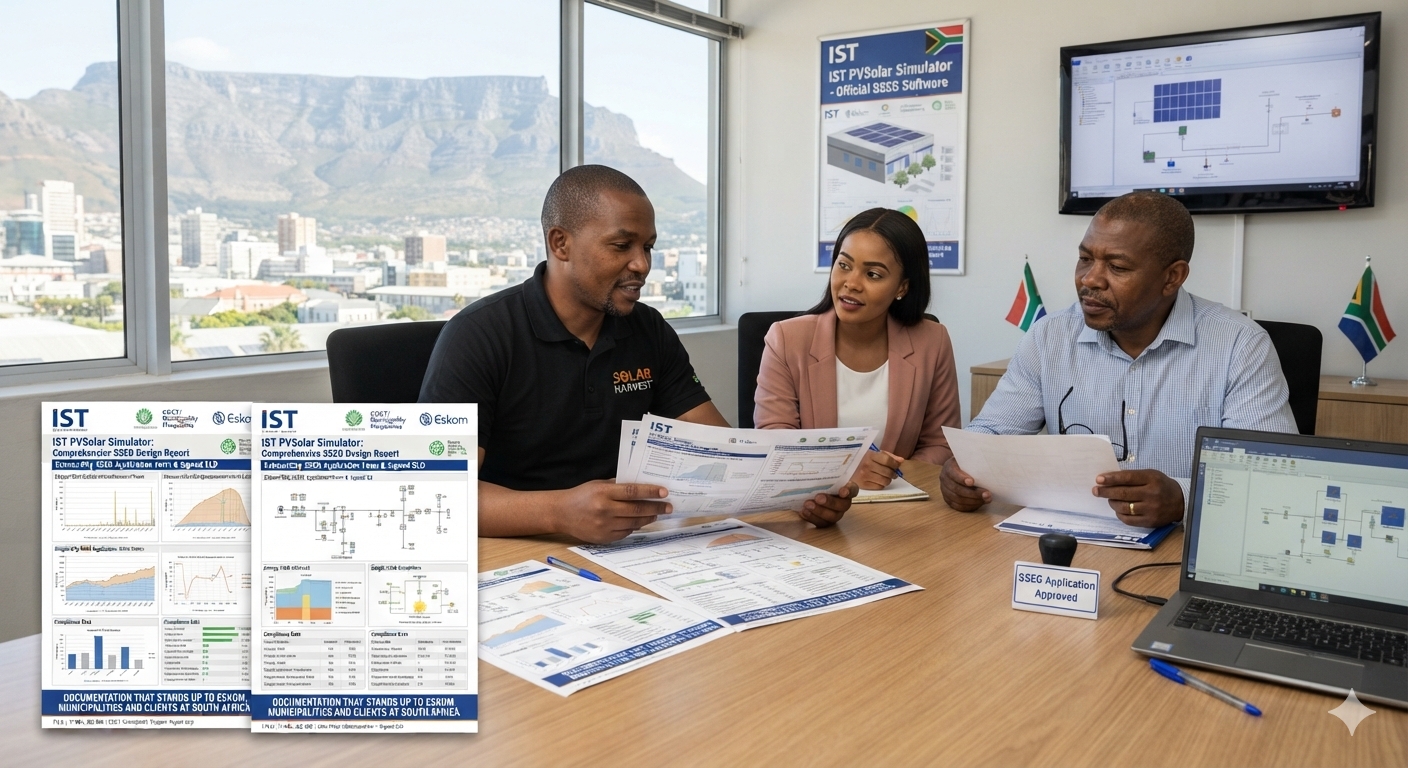
Documents That Stand Up to Eskom, Municipalities and Clients
For a Small-Scale Embedded Generation (SSEG) installer, the engineering is only half the job. The other half is paperwork: the drawings a network operator will review, the quantities a client will check, the quotation that wins the job, and for commercial customers, the report their financier wants to see. Each document is read by someone trained to spot the gap between what is claimed and what is supported.
IST PVSolar Simulator is built around the idea that every document should trace back to one validated calculation. This article shows how that helps SSEG installers, using the platform's own description of how its PDF reports are produced.
The SSEG paperwork reality
In South Africa, grid-tied embedded generation under 100 kW must be registered with the electricity supplier, which is either Eskom or the local municipality. Public guidance describes a compliance stack that typically includes SSEG registration, an inverter that meets NRS 097-2-1, a Certificate of Compliance from a registered electrical contractor, and written approval from the network operator before energising. Registration fees, tariffs and processes differ between Eskom and municipalities, and they change over time, so always confirm the current requirements with the supplier.
For the installer, that means every job needs documents that are accurate, consistent and quick to produce. A mismatch between the single-line diagram and the quotation, or between the string layout and the inverter's limits, costs time at best and a rejected application at worst.
One project, eight deliverables
The table below shows the documents an SSEG installer commonly needs and what each is for.
|
Deliverable |
What it is for |
|---|---|
|
Project document |
A record of the site, design basis, equipment, results and assumptions |
|
Single-line diagram (SLD) |
Shows the array, inverter, protection and grid connection for the network operator and electrical contractor |
|
String table layout |
Shows how modules are grouped into strings and assigned to inverter inputs |
|
String DC circuit diagram |
Shows the DC wiring from strings to the inverter inputs |
|
Bill of quantities (BOQ) |
Lists items and quantities for procurement and pricing |
|
Quotation |
The commercial offer for the customer |
|
Detailed Project Report (DPR) |
A fuller technical and financial case, useful for larger commercial jobs |
|
Bankability report |
A risk and coverage assessment for customers who need finance |
The platform's published material describes the SLD, wiring schedules, EPC proposal with BOQ, DPR and bankability report. The string table layout and string DC circuit diagram belong to the same electrical design data. Check the exact formats in your own project before you promise them to a client or the network operator.
Why the source of the numbers matters
According to the site, every figure in a generated report, including monthly irradiance, energy, performance ratio, specific yield and the P10, P50, P75, P90 and P95 probability table, comes from the hourly or sub-hourly simulation run on the same inputs. There is no separate reporting layer that recomputes a simplified version of the numbers for display. That matters to an installer for a practical reason. When a customer or reviewer asks how you got a number, the answer is traceable.
The platform states that its report follows IEC 61724-1 for performance reporting and IEC 61853 for module performance modelling, and that its declaration page references BIS, CEA and MNRE technical standards. These are the standards the platform names for its Indian use. South African installers should treat them as a technical foundation and still check the documents against NRS 097-2-1, SANS 10142-1, the supplier's SSEG requirements and any municipal rules that apply. Compliance with local requirements remains the responsibility of the installer and the registered electrical contractor.
Electrical documents built from checked equipment data
The SLD and wiring diagram are generated from the electrical solution computed for your specific module, inverter, string configuration and cable routing. According to the site, voltage drop, MPPT current limits and inverter DC voltage windows are checked against the selected equipment's datasheet parameters before the diagram is drawn. The diagram therefore reflects a design that passed the checks, rather than an idealised template with your project name added.
For installers, that has three practical benefits:
- Fewer site surprises. String voltage at the coldest temperature and current limits are checked before the drawing is issued, not discovered on the roof.
- Consistency. The string table, DC circuit diagram and SLD come from the same configuration, so they agree.
- Faster reviews. Network operators and electrical contractors can follow a design where the numbers add up.
For larger plants, the platform's report extends to grid interconnection and LT panel busbar diagrams, generated from the same equipment schedule.
BOQ and quotation without retyping
The cost side is built line by line, with quantities, unit rates and tax rates for modules, inverters, mounting, cabling, protection and installation. From that data the platform generates an EPC proposal that includes CAPEX, BOQ, schedule, financial summary and terms. Reusable company and customer profiles mean you do not retype your details on every quote. For an installer issuing several quotations a week, that is where the time saving appears.
Bankability and the customer's finance case
Most SSEG jobs do not need a bankability report. Larger commercial and industrial customers, and those using finance, often do. The platform's bankability assessment scores a project against benchmarks lenders commonly apply, including module efficiency, temperature coefficient and degradation thresholds, inverter manufacturer status and warranty against the debt tenor, EPC contract structure and guarantee levels, and legal and country risk. According to the site, each risk flag states the reason it was raised, with the specific figure and benchmark behind it, so a reviewer can trace every high-risk label to what triggered it.
For an installer, this is a way to anticipate a financier's questions before they arrive. If a module's degradation rate or an inverter's warranty term would be flagged, you can choose differently or explain it.
The DPR for larger commercial jobs
For larger projects, a Detailed Project Report gathers the technical, financial and risk case into one document. The platform's DPR feature builds a draft from your own project data, with placeholders for details the software cannot know. It is a draft for review, so have a qualified engineer check it before issue.
Inputs checked before documents are produced
A document is only as good as its inputs. According to the site, the platform checks numeric inputs such as tilt, azimuth, latitude, cable lengths and financial parameters against ranges before they reach the simulation engine, so a typo does not become a nonsensical yield printed as fact. Uploaded project and site-data files are also validated before their contents are trusted. These checks reduce the chance of an embarrassing error in a document you hand to a customer or reviewer.
An SSEG installer's workflow
- Create the project, enter the site and import a weather year.
- Draw the roof faces and run the shading analysis.
- Select modules and inverters, then build the sub-arrays and strings.
- Review the electrical checks and fix any warnings.
- Enter the customer's tariff, costs and, where relevant, the export rule and tax settings.
- Run the simulation and review generation, savings and payback.
- Generate the SLD, string layout, DC circuit diagram, BOQ and quotation.
- For larger jobs, generate the DPR and bankability report, and have an engineer review them.
- Prepare your supplier application and the Certificate of Compliance process separately, as the supplier requires.
Who benefits
|
User |
Benefit |
|---|---|
|
Residential SSEG installers |
Quick, consistent drawings, BOQ and quotations |
|
Commercial and industrial installers |
Self-consumption analysis, DPR and bankability support |
|
Electrical contractors |
Checked string and DC designs before site work |
|
Small EPC teams |
Less retyping and fewer mismatches between documents |
|
Sales teams |
Clear savings and payback numbers from the same model |
Frequently asked questions
Does IST PVSolar Simulator replace SSEG registration? No. It supports accurate design and documents. Registration, supplier approval and the Certificate of Compliance remain the installer's responsibility.
Are the generated documents consistent with each other? According to the site, they come from the same calculation and equipment schedule, so the SLD, string layout, BOQ and reports stay aligned when the design changes.
Does the report follow South African standards? The platform names IEC 61724-1, IEC 61853 and Indian BIS, CEA and MNRE standards. Check the output against NRS 097-2-1, SANS 10142-1 and your supplier's SSEG rules before submission.
Do I need a bankability report for every job? No. It is most useful for larger commercial customers and those using finance.
Can I trust the draft DPR as it is? No. Treat it as a draft. Fill the placeholders, close the data gaps and have a qualified engineer review it.
Paperwork that survives review
A polished PDF is easy to produce. A document set that survives a network operator, an electrical contractor and a customer's financier is harder, because each reader looks for the gap between the claim and the evidence. With IST PVSolar Simulator, the SLD, string layouts, BOQ, quotation and reports come from one validated project, so the answer to how you got a number is always traceable.
Read the source article, IST PVSolar Simulator PDF Actually Means Something, explore the product page, or create an account to try it on your next SSEG job.