
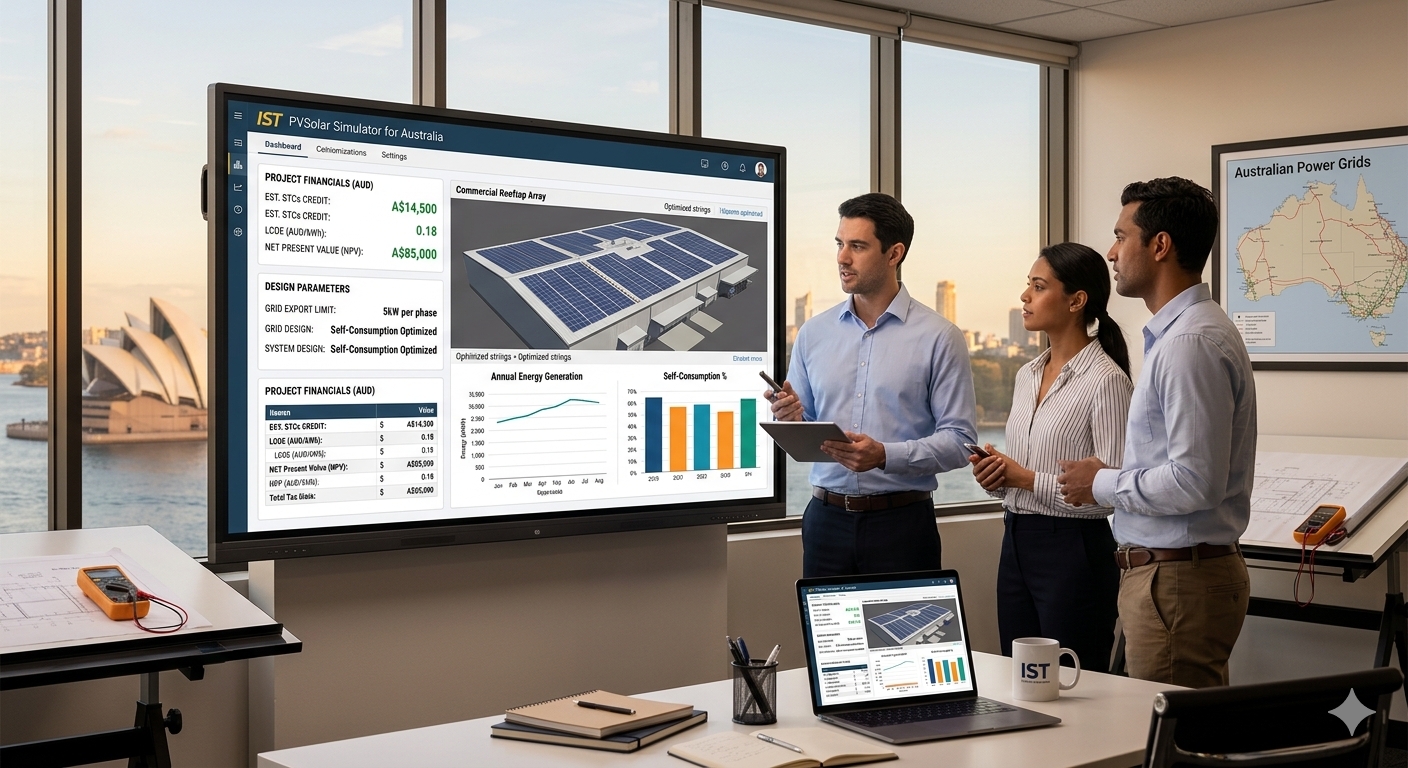
IST PVSolar Simulator for Australia Design in AUD
Australia has some of the highest rooftop solar penetration in the world, and a market that rewards careful design. Export prices are low, grid import prices are high, and a federal rebate scheme shapes upfront cost. In that environment, a design that ignores local rules can look attractive in a spreadsheet and disappoint in practice.
IST PVSolar Simulator is built around one idea: set up the project once, run one simulation, and let the country's currency, tax and export rules shape every report that follows. This article shows how that fits Australia.
Why Australia needs a country-aware simulator
Several features make Australian projects different from most markets.
- Self-consumption beats export. Reported feed-in tariffs sit roughly between 1 and 10 cents per kWh in most states, while grid import rates are often reported at 30 to 40 cents per kWh. The value of a kilowatt-hour used on site is many times the value of one exported.
- A federal rebate delivered through certificates. The Small-scale Renewable Energy Scheme (SRES) gives eligible solar systems an upfront discount through Small-scale Technology Certificates (STCs), and the Cheaper Home Batteries Program extends the same mechanism to batteries.
- A scheduled phase-down. The SRES is set to wind down toward 2030. The solar deeming period is reported to fall from five years to four on 1 January 2027, and the battery STC factor from 6.8 to 5.7.
- Network-level export limits. Distribution network service providers (DNSPs) set their own limits, including flexible or time-of-export arrangements in some regions such as South Australia.
- State-by-state differences. Feed-in tariffs, retailer offers and network rules vary by state and by retailer.
A simulator that hard-codes one export rule would mislead you. IST PVSolar Simulator treats the export scheme, price, term and size limits as editable inputs.
The country data that drives an Australia project
The simulator stores country-wise defaults for the inputs below. The table shows what each means for an Australian project and the publicly reported context. Where a figure depends on the state, retailer, network or the current default in the software, the table says so.
|
Input in the simulator |
Australia context |
|---|---|
|
Currency |
Australian dollar (AUD, A$). |
|
Currency rate per 1 US$ |
Enter the live rate when you build the project. |
|
Electricity tariff |
Varies by state, retailer and tariff type. Many tariffs are time-of-use, with reported import rates of roughly 30 to 40 cents/kWh. Enter the customer's actual rate and time bands from their bill. |
|
Tariff escalation (%/yr) |
An editable assumption. Run low, base and high cases. |
|
Discount rate (%) |
An editable assumption reflecting your cost of capital. |
|
VAT / GST on equipment |
Australia applies GST, generally 10%. Confirm the treatment for the customer's GST registration and the way STC discounts are shown on the invoice. |
|
CO₂ grid factor (kg/kWh) |
Published grid factors differ by state, so use the state figure rather than one national number. Confirm the default in the simulator against the latest published factors. |
|
Corporate tax (%) |
Depends on company type and turnover. Confirm the applicable rate with your tax adviser. |
|
Depreciation |
Choose straight-line, declining-balance or custom in the financial model. Small-business asset write-off rules change from year to year, so confirm the current treatment with an adviser. |
|
Export scheme |
Retailer feed-in tariff, with the amount set by the retailer and state rules. Some customers are on plans that pay little or nothing for exports. |
|
Export fixed price (price/kWh) |
Reported ranges are about 1 to 10 cents/kWh in most places, with some time-of-export offers higher. Examples reported for July 2026 include 3 cents/kWh for one NSW retailer plan and 6.006 cents/kWh for the regulated Ergon rate in regional Queensland. Use the customer's actual plan. |
|
Export credit (× tariff) |
Exports are normally paid at a fixed cents-per-kWh price, not as a multiple of the retail tariff. |
|
Export rule lasts (years) |
Set by the retailer plan. Many feed-in rates are reset annually or on plan changes, so model a conservative case. |
|
After the term |
Model a low or zero export price after the plan term, so the result does not depend on a rate that may not last. |
|
Export only for systems ≥ / ≤ (kWp) |
SRES eligibility is reported as systems under 100 kW, with larger commercial systems typically earning certificates under a different scheme. One recent article says SRES coverage expanded to 1 MW in October 2026, which I could not confirm elsewhere, so check the Clean Energy Regulator. DNSPs also set per-connection export limits. |
|
Utility name |
The local DNSP, and the customer's retailer. The Clean Energy Regulator administers the SRES, and the Australian Energy Regulator oversees the retail market. |
|
Grid-connection approval |
Application to the DNSP, installation by an accredited installer, and an inverter that meets the network's requirements. Reported design standards include AS/NZS 5033 for the array. |
|
Net-metering / export policy |
Not net metering in the usual sense. Exports are credited as a feed-in tariff. Time-of-export and flexible-export arrangements apply in some regions. |
|
Export explanation |
The simulator shows how the export rule is applied, so a reader can see how the revenue was calculated. |
A note on accuracy: these figures come from public reporting and policy summaries, not from a certified rulebook. Every field in IST PVSolar Simulator is editable, and administrators can update a country's values with the date and source shown.
STCs and the Cheaper Home Batteries Program
Because STCs reduce the upfront price, the simulator lets you enter the rebate as a reduction in CAPEX, so payback and IRR are calculated on the net cost.
For batteries, reporting says the federal program launched on 1 July 2025. From 1 May 2026 the STC factor fell from 8.4 to 6.8 per kWh of usable capacity, and support is tiered by size: full factor up to 14 kWh, 60% from 14 to 28 kWh and 15% from 28 to 50 kWh. A further cut to 5.7 is reported for 1 January 2027. Because the settings keep changing, check the latest figures on the Department of Climate Change, Energy, the Environment and Water website before you quote.
Designing for self-consumption
When exports earn little, the design questions change:
- Size the array to the daytime load rather than the roof area alone.
- Test whether a battery lets you shift midday generation to the evening peak.
- Compare a larger export-limited system against a smaller self-consumption system on payback and IRR.
- Include the DNSP export limit in the model so the clipped energy is counted honestly.
The platform supports hourly battery dispatch against an imported or estimated load profile, so you can run these comparisons in one project instead of in separate spreadsheets.
One simulation, every document
The core promise of the platform is that a single run feeds every output:
- Energy yield, performance ratio and a full loss waterfall.
- P50, P75, P90 and P95 yields with Monte Carlo uncertainty.
- A single-line diagram, array table, cable schedule and protection schedule.
- NPV, project and equity IRR, LCOE, payback and DSCR, in Australian dollars.
- A bankability report, a Detailed Project Report and an EPC proposal with a bill of quantities.
Change the module, the tariff or the export limit, run again, and every document updates together.
Engineering that suits Australian sites
The engine follows international methods, including IEC 61724-1 performance accounting, IEC 61853 module rating, a single-diode cell model, Perez transposition and IEC 60364-7-712 for PV electrical design. The simulation runs hourly or every 15 minutes. It supports 3D shading, mixed-orientation arrays (common on Australian roofs with several planes), bifacial and single-axis tracker simulation for ground-mounted plants, and editable thermal, soiling and degradation losses. Weather data can be imported from PVGIS or NASA POWER in one click, or from your own hourly file.
Who benefits in Australia
|
User |
What they get |
|---|---|
|
Residential and commercial installers |
Quick quotations, BOQ and drawings that support network applications |
|
Farms, factories and retailers |
Self-consumption, export-limit and battery analysis in AUD |
|
Developers and investors |
Bankability metrics, DSCR and risk analysis |
|
Consultants and lender's engineers |
Transparent losses, P-values and uncertainty |
|
Universities and trainers |
Research and teaching tools for solar design |
A seven-step workflow for an Australia project
- Select Australia, enter the site and import a weather year.
- Set orientation for each roof plane and run shading checks.
- Choose modules and inverters and build the sub-arrays.
- Review loss assumptions, especially soiling, temperature and degradation.
- Enter CAPEX net of rebates, OPEX, financing, the customer tariff, the export price and limit, and the tax settings.
- Run the simulation, with and without a battery.
- Generate the SLD, schedules, bankability report and DPR.
Official Australian references
-
-
Australian Energy Regulator — Export limit guidance.
-
Clean Energy Council — Australian solar industry and technical resources.
Recommended positioning: IST PVSolar Simulator — Australian Solar Design, STC-Aware Financial Modelling and Export-Limit Optimisation in AUD.
The strongest proposition for Australian EPCs and developers is a single workflow that connects site-specific energy yield to self-consumption, export constraints, eligible incentives and project economics—rather than relying on generation estimates alone.
Frequently asked questions
Does IST PVSolar Simulator support Australian rebates and export limits? Yes. You can enter the STC discount as a CAPEX reduction and set the export price and limit to match the customer's plan and network.
Can I work in Australian dollars? Yes. The platform supports multi-currency costing, so CAPEX, OPEX, tariffs and returns can be shown in AUD.
Can I model solar plus battery? Yes. The platform includes hourly battery dispatch, sizing and backup-autonomy tools.
Are the Australia defaults guaranteed to be current? No. Defaults are editable and should be checked against the latest Clean Energy Regulator, retailer and DNSP information before submission.
Does it replace network approval? No. It supports a well-documented design, while network applications, installer accreditation and equipment certification remain the project team's responsibility.
Design once, deliver in Australian dollars
Australia's solar rules change often and vary by state, retailer and network, so the most useful tool is one that lets you change assumptions without rebuilding the project. With IST PVSolar Simulator, the yield, the finances and the paperwork come from one run, in the currency and rules of the market you are building in.
Read the original One Simulation, Every Report, Any Country article, explore the product page, or create an account to start your first Australia project.