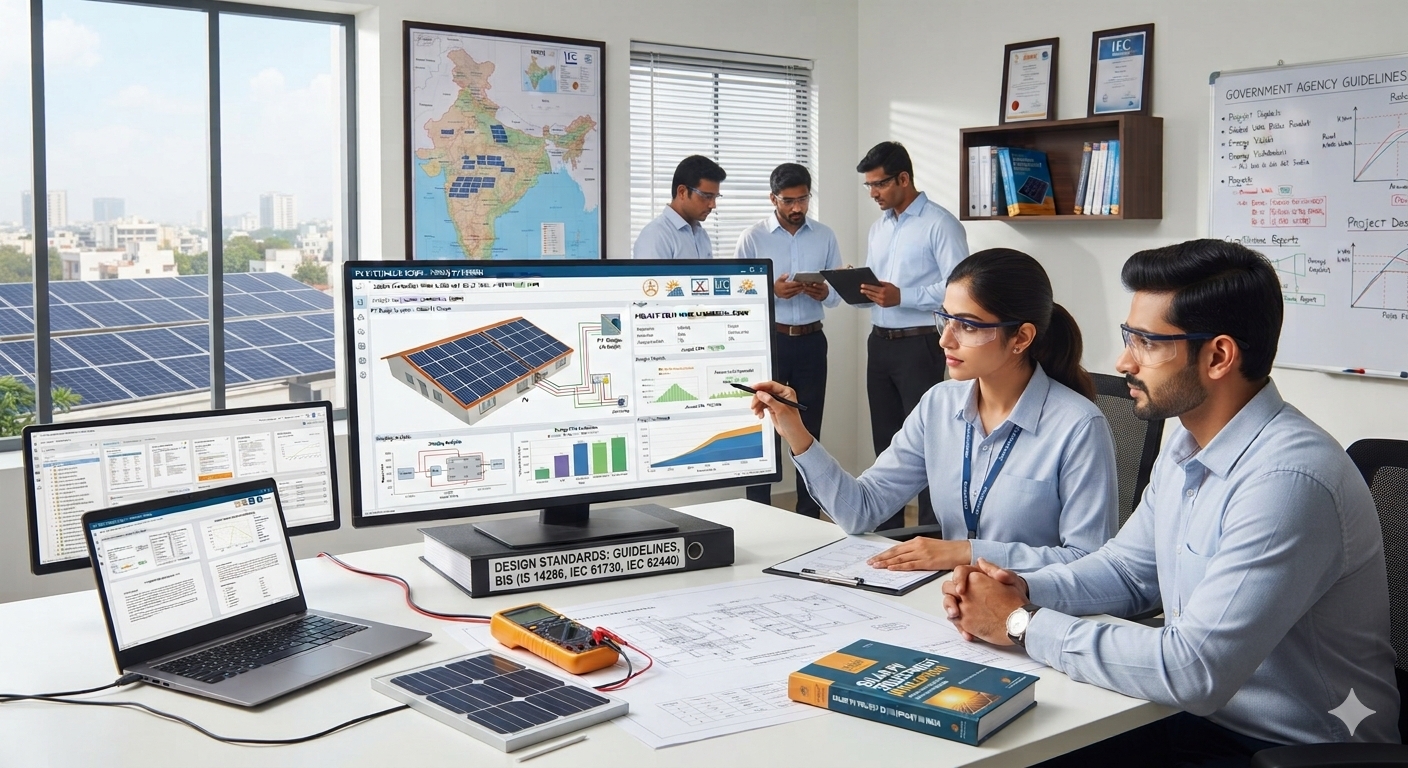
This is where a standards-aware Indian solar simulator (PV design and simulation software) helps. IST PVSolar Simulator is one such platform. It is built for the Indian market and covers yield simulation, electrical design, bankability analysis and reporting in one workflow.
Why standards matter in solar simulation
A simulation is only as credible as the method behind it. Three groups of standards shape a PV design in India.
MNRE (Ministry of New and Renewable Energy) sets the policy and programme framework. This includes the ALMM (Approved List of Models and Manufacturers) for modules, subsidy and scheme guidelines such as PM Surya Ghar, and the emissions factors used for carbon reporting.
BIS (Bureau of Indian Standards) covers product quality and safety. Modules and inverters used in Indian projects must comply with the relevant IS standards, many of which are harmonised with IEC standards. Examples are IS 14286 for crystalline silicon module qualification and IS 16169 for module safety. Check the current edition for your product category.
IEC (International Electrotechnical Commission) provides the global technical basis for module testing, electrical installation, array design and performance analysis. This is the language lenders and international EPCs expect.
A simulator that connects all three lets a design engineer work in one place and avoid rebuilding documents for every stakeholder.
Indian Solar Simulator: Designing PV Projects to MNRE, BIS and IEC Standards
What a standards-based Indian solar simulator should do
1. Hourly, physics-based yield simulation
Monthly approximations don’t hold up in due diligence. IST PVSolar Simulator runs a full 8,760-step hourly simulation (with 15-minute sub-hourly runs) using single- and two-diode module models. This gives a realistic generation profile over the project’s life, which matters for monsoon-affected sites and for self-consumption analysis.
2. Transparent loss accounting
Every loss should be visible and editable, not hidden in one derate factor. The platform models the energy chain from GlobHor to GlobInc, GlobEff, E_Array and E_Grid. Individual losses include:
- Thermal and IAM losses
- Spectral effects
- Soiling, which is significant in dusty Indian conditions
- LID and ageing
- Mismatch, wiring and clipping
- Shading and bifacial gain
This approach follows the loss-accounting logic reviewers expect in a bankability report.
3. Electrical and protection design to IEC and CEA norms
String sizing, cable schedules and protection ratings are generated from the layout. The platform references IEC 60364-7-712, IEC 60269-6 and CEA 2010, alongside India’s IS 16169. Single-line diagrams, array tables and protection schedules come from the same design, so drawings stay consistent with the simulation.
4. ALMM-ready module data
Under MNRE’s ALMM framework, module selection is no longer only a technical decision. A simulator that supports ALMM-ready module data and flexible imports (manufacturer .PAN/.OND files, datasheet extraction or manual entry) keeps the workflow moving when files are missing.
5. Bankability and risk analysis
Lenders want P50, P75, P90 and P95 exceedance values, not a single number. The platform combines the hourly yield engine with a Monte-Carlo financial risk analysis (5,000 trials). It reports LCOE, NPV, IRR, Equity IRR and DSCR, and includes a lender due-diligence checklist.
6. India-specific reporting
The platform supports MNRE CO₂ factors, INR-based costing with GST-aware pricing, and PM Surya Ghar and DPR-style report layouts. For larger projects, multi-currency and country-specific tax frameworks let you re-cost the same simulation for other markets.
From design to deliverable
A typical workflow looks like this:
- Site and resource: import irradiance from PVGIS, NASA TMY or Meteonorm/SolarGIS data.
- Layout and shading: model 3D near-shading, horizon profiles, bifacial gain or single-axis tracking.
- Component selection: choose ALMM-ready modules and inverters.
- Electrical design: size strings, then generate cable and protection schedules.
- Simulation: run the hourly yield and review the loss waterfall.
- Bankability: run P-value and Monte-Carlo analysis.
- Reporting: export the SLD, BOQ, DPR-style document and investor-ready PDF.
Because each step feeds the next, nothing has to be re-typed or re-verified downstream.
Who benefits
- Rooftop EPCs and installers get faster proposals with consistent documentation.
- C&I developers can run self-consumption and battery dispatch scenarios against a load profile.
- Utility-scale developers get risk-adjusted yield and financing metrics.
- Consultants, lenders and independent engineers get an auditable record of how the numbers were produced.
- Students and researchers can use the sensitivity and uncertainty tools to learn how loss assumptions affect results.
Important note on compliance
Using a simulator that references MNRE, BIS and IEC standards supports a compliant design. It does not replace testing, certification or approvals. Module and inverter certification, ALMM listing, discom approval and CEA regulations remain the responsibility of the project team. Always confirm the latest MNRE orders and BIS editions before finalising a design.
Try it yourself
IST PVSolar Simulator offers a free plan for evaluation, with reports watermarked as a demo version, and paid plans for full access. You can explore the features on the product page or create an account.
Frequently asked questions
Is IST PVSolar Simulator suitable for PM Surya Ghar rooftop projects? Yes. It includes PM Surya Ghar and DPR-style report layouts, ALMM-ready module data and INR-based costing, so rooftop proposals can be prepared in one workflow.
Which standards does the platform reference? It references IEC 60364-7-712, IEC 60269-6, CEA 2010 and IS 16169 for electrical and protection design, and uses MNRE CO₂ factors for emissions reporting.
Does it need .PAN or .OND files? No. You can import them, extract data from PDF datasheets, or enter component data manually.
Can it model bifacial modules and trackers? Yes. It supports view-factor bifacial gain, 3D and LiDAR near-shading, horizon import and single-axis tracker backtracking.
Is there a free plan? Yes. A free plan is available for evaluation, with demo-watermarked PDF reports. Paid plans unlock full access.