A solar plant in Nairobi, Kuala Lumpur, Lagos and Pune all face the same sunlight physics. The money side looks very different. Currency, VAT, grid export rules, tax depreciation and the names of the utilities and standards bodies change from one border to the next. Many design teams handle this by rebuilding spreadsheets and report templates for every new market.
The better approach is to keep one trusted engineering core and let the local rules sit on top of it. That is the idea behind IST PVSolar Simulator: one simulation, one set of internationally recognised methods, and reports that adapt to the country where the plant will be built.
Why a global standard matters
Lenders, EPCs and independent engineers in different countries rarely share a local rulebook. What they do share is a set of international methods that make results comparable and auditable. When your yield estimate follows these methods, a reviewer in any market can follow how you got your number. “One Simulation, Every Report, Any Country” reworded it. About 125 countries, editable tariff and tax defaults, and the IEC methods come from the site’s own material.
IST PVSolar Simulator builds its engineering core on these recognised foundations:
- IEC 61724-1 for performance and loss accounting.
- IEC 61853 for module rating.
- A single-diode (De Soto) cell model for module behaviour.
- Perez sky transposition to convert horizontal irradiance to the tilted plane of the array.
- IEC 60364-7-712 for PV electrical design.
Because the same core runs in every country, a project in one market can be compared fairly with a project in another.
Local rules, applied on top
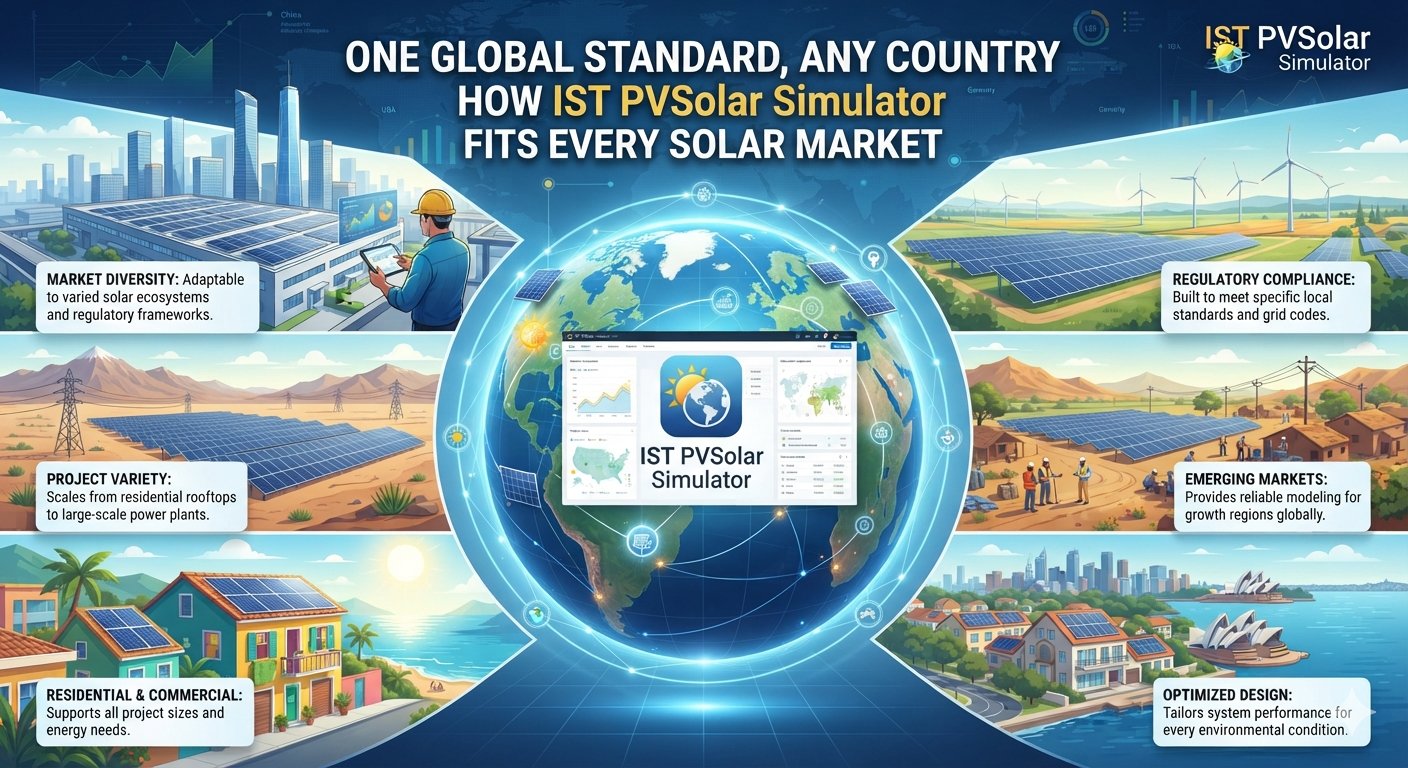
The engineering physics stays constant. The commercial and regulatory layer is what you change when you select a country. According to the platform's own published material, the country list covers 125 markets across South Asia, Southeast Asia, Africa and Europe, plus the USA, UAE, Saudi Arabia and Australia.
Selecting a market adapts the project in several ways:
- Currency and number format, so costs and returns read naturally for local stakeholders.
- VAT or GST on equipment, applied per item with input-tax credit where relevant.
- Tariff, escalation and discount-rate defaults, all editable to match your own assumptions.
- Grid export treatment, such as net metering, net billing, feed-in or no export credit, because the value of exported solar differs sharply between countries.
- Tax and depreciation presets, since corporate tax treatment and allowable depreciation vary by jurisdiction.
- Standards and utility wording, so reports refer to the local utility and the local regulatory framework.
The point is not that the software knows every rule perfectly. Rules change, so every default is editable, and the platform lets administrators update a country's tariff, VAT, export rule or tax preset with the date and source shown to users. You should still verify current local rules before submitting any report.
Weather data that works anywhere
A global platform needs global solar resource data. IST PVSolar Simulator can import a typical year from PVGIS or NASA POWER, or accept your own hourly file from sources such as Solargis, Meteonorm, Solcast, NSRDB, PVsyst or EPW. It reads the time zone and aligns the data to solar time before the run, so a site in any hemisphere is handled consistently.
One simulation, every document
Most teams lose time between tools: yield in one program, finance in a spreadsheet, drawings in CAD and the feasibility report in a word processor. Every hand-off risks a mismatch.
With IST PVSolar Simulator, you set up the site and system once and run the simulation once. The outputs then draw from that same result:
- Energy yield, performance ratio and loss waterfall.
- P50, P75, P90 and P95 exceedance values with Monte Carlo uncertainty.
- Electrical design outputs such as single-line diagrams, array tables, cable and protection schedules.
- Financial results including NPV, project and equity IRR, LCOE, payback and DSCR.
- A lender-oriented bankability report and a Detailed Project Report.
- EPC proposals with a bill of quantities.
Change the module, the tariff or the tax preset, run again, and every document updates together.
Engineering depth behind the run
A global tool is only useful if the engineering is credible everywhere. The simulation runs hourly or sub-hourly across a full year and then across the project life with degradation. It covers:
- 3D shading with horizon and near-object analysis.
- Bifacial gain and single-axis tracker simulation with backtracking.
- Module thermal behaviour, mismatch, LID, spectral and soiling losses.
- Inverter efficiency and clipping.
- Battery storage sizing and dispatch for self-consumption projects.
- A Research tab with sensitivity analysis and IEC 61724 loss accounting for studies and publications.
Who benefits
|
Audience |
Benefit |
|---|---|
|
EPCs and installers |
Quotation, BOQ and schedules generated from the same design |
|
Project developers |
Yield, returns and a DPR in local currency and rules |
|
Consultants and lender's engineers |
Transparent P-values, uncertainty and DSCR to review |
|
C&I buyers and investors |
Clear view of self-consumption, export credit and payback |
|
Students and researchers |
Sensitivity and uncertainty analysis for papers and projects |
A practical workflow for any market
- Choose the country and enter the site location.
- Import the weather year or upload your own file.
- Set orientation, then select modules and inverters.
- Confirm the loss assumptions.
- Enter CAPEX, OPEX, financing, the export rule and the tax preset.
- Run the simulation.
- Generate the reports and drawings.
Frequently asked questions
Can I use IST PVSolar Simulator outside India? Yes. It supports multi-currency costing and country-specific tax, tariff and export frameworks, and is designed for projects anywhere in the world.
Which international standards does it follow? Its core references IEC 61724-1, IEC 61853 and IEC 60364-7-712, along with a single-diode cell model and Perez transposition.
Can I bring my own weather data? Yes. You can import PVGIS or NASA POWER data, or upload hourly files from providers such as Solargis, Meteonorm, Solcast, NSRDB, PVsyst or EPW.
Are local tariffs and tax rules guaranteed to be current? Defaults are editable and updated by administrators with a date and source, but you should always confirm current local regulations before submitting a project.
Does it replace local approvals? No. It supports a well-documented design, but certification, grid approvals and permits remain the project team's responsibility.
Design once, deliver everywhere
A solar project is one plant, so it should be one model. Whether you are building in South Asia, Africa, Europe or the Middle East, IST PVSolar Simulator keeps the engineering consistent and adapts the commercial layer to the country.
Explore the product page, read more on the IST PVSolar Simulator articles page, or create an account to run your first project.