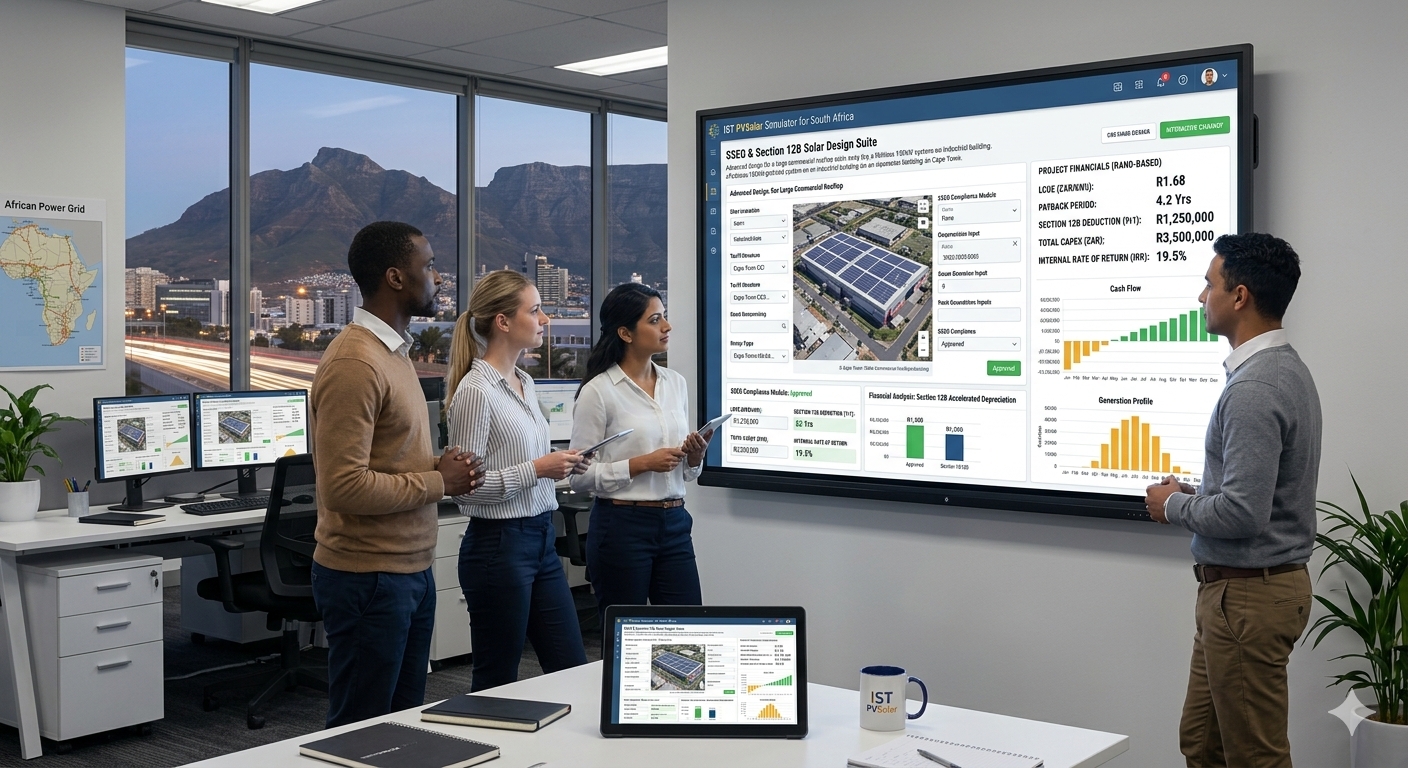
South Africa has one of the most active rooftop solar markets on the continent, driven by years of load-shedding and high electricity costs. Rooftop capacity has grown rapidly, and the rules around it have grown with it. Registration, inverter compliance, municipal tariffs and tax incentives all affect whether a project works on paper and in practice.
IST PVSolar Simulator is built around one idea: set up the project once, run one simulation, and let the country's currency, tax and export rules shape every report that follows. This article shows how that fits South Africa.
Why South Africa needs a country-aware simulator
South Africa does not have one national export rule. It has a layered system, and a design tool has to respect it.
- Two kinds of supplier. Some customers buy directly from Eskom, others from one of the licensed municipal distributors. Each has its own application process, fees and tariffs.
- Registration is mandatory. Grid-tied embedded generation under 100 kW must be registered with the electricity supplier as Small-Scale Embedded Generation (SSEG). NERSA clarified in February 2026 that registration depends on having a grid connection and installed capacity, not on whether power is exported.
- Varied export treatment. Some municipalities pay for exported energy through feed-in tariffs, others offer limited or no credit, and many customers design for self-consumption.
- A strong tax incentive. Section 12B allows businesses to write off qualifying solar investment quickly, which can shorten payback.
- Unreliable supply. Many commercial and industrial users want solar plus batteries for backup, not just bill savings.
A simulator that hard-codes one export rule would mislead you. IST PVSolar Simulator treats the export scheme, price, term and size limits as editable inputs.
The South African configuration should be built around three priorities:
-
SSEG compliance: grid-connected embedded generation registration and the applicable municipal or Eskom requirements.
-
Section 12B tax modelling: evaluate potential qualifying renewable-energy tax deductions without treating them as guaranteed cash rebates.
-
Rand-based financial analysis: model project CAPEX, VAT, electricity savings, export income, O&M, NPV, IRR and payback in South African rand (ZAR/R).
South Africa's regulatory position was clarified by NERSA in February 2026, so a current local configuration is particularly important.
The country data that drives a South Africa project
The simulator stores country-wise defaults for the inputs below. The table shows what each means for a South African project and the publicly reported context. Where a figure depends on the municipality, tariff category or the current default in the software, the table says so.
|
Input in the simulator |
South Africa context |
|---|---|
|
Currency |
South African rand (ZAR, R). |
|
Currency rate per 1 US$ |
Enter the live rate when you build the project. The rand moves materially, so test a range. |
|
Electricity tariff |
Depends on whether the site is on an Eskom or a municipal tariff, and on the customer category. Eskom has moved registered solar users toward time-of-use tariffs such as Homeflex, so enter the rate and time bands from the customer's own bill. |
|
Tariff escalation (%/yr) |
An editable assumption. South African tariffs have risen sharply over the past decade, so run low, base and high cases. |
|
Discount rate (%) |
An editable assumption reflecting your cost of capital in rand. |
|
VAT / GST on equipment |
VAT is levied on equipment, with input-tax treatment for VAT-registered businesses. Confirm the current rate and your VAT status. |
|
CO₂ grid factor (kg/kWh) |
Eskom supplies about 95% of national electricity and coal made up roughly 82% of generation in 2023, so the grid factor is high compared with most countries. Confirm the default in the simulator against the latest published factor. |
|
Corporate tax (%) |
Depends on company type. Confirm the applicable rate with your tax adviser. |
|
Depreciation |
Section 12B is the key preset: reported as a 100% first-year allowance for qualifying solar systems (reported as below 1 MW). The older Section 12BA 125% deduction is reported to have expired on 28 February 2025, so do not use it in new models. |
|
Export scheme |
Varies by supplier. Feed-in or buy-back tariffs in some municipalities, limited or no credit elsewhere. Model the rule of the customer's own supplier. |
|
Export fixed price (price/kWh) |
Municipal rates vary widely. A public summary lists older figures such as R0.7008/kWh in Cape Town and R0.4279/kWh (residential) in Johannesburg, but those come from earlier tariff years. Check each municipality's current tariff book. |
|
Export credit (× tariff) |
Where an export credit applies, it is generally a fixed buy-back price rather than a multiple of the retail tariff. Confirm with the supplier. |
|
Export rule lasts (years) |
Not set nationally. It depends on the municipal policy or agreement, so enter the term in the customer's contract. |
|
After the term |
Model a conservative case, such as self-consumption only, for years beyond any agreed export period. |
|
Export only for systems ≥ / ≤ (kWp) |
SSEG registration applies below 100 kW, and reporting says systems of 1 MW and above fall under NERSA's Small Project IPP framework. Eskom's registration fee waiver is reported to cover systems up to 50 kVA. Check the supplier's own size limits. |
|
Utility name |
Eskom, or the local municipal distributor such as City of Cape Town, City Power Johannesburg, eThekwini, Ekurhuleni or Tshwane. NERSA is the regulator. |
|
Grid-connection approval |
Written SSEG approval from Eskom or the municipality before energising. Reported requirements also include an NRS 097-2-1 compliant inverter and a Certificate of Compliance from a registered electrical contractor. |
|
Net-metering / export policy |
Set by the supplier. Eskom's SSEG framework and each municipality's policy differ, so confirm before you model export revenue. |
|
Export explanation |
The simulator shows how the export rule is applied, so a reader can see how the revenue was calculated. |
A note on accuracy: these figures come from public reporting and policy summaries, not from a certified rulebook. Every field in IST PVSolar Simulator is editable, and administrators can update a country's values with the date and source shown. Reporting is also inconsistent on a few details, such as how long Eskom's registration fee waiver runs, so check the current position with Eskom or your municipality.
Why Section 12B changes the financial model
For a business that qualifies, a fast first-year write-off lowers the effective cost of the system and can shorten payback noticeably. It also means the choice of depreciation setting in your model matters. A model that uses an expired allowance would overstate the tax benefit and could cause disputes with the client. In IST PVSolar Simulator, depreciation and tax are explicit inputs, so you can set the treatment that applies and show the client exactly how it feeds into NPV, IRR and payback.
Self-consumption, storage and the load-shedding case
In many South African projects, the value of solar is not export revenue. It is avoided grid purchases and avoided diesel generation during outages. That changes the design questions:
- Size the array to the daytime load rather than the roof area alone.
- Test whether a battery covers evening peaks and outage periods.
- Compare a grid-tied design, a hybrid design and a zero-export design on payback and risk.
The platform supports hourly battery dispatch against an imported or estimated load profile, plus backup-autonomy tools, so you can run these comparisons in one project.
One simulation, every document
The core promise of the platform is that a single run feeds every output:
- Energy yield, performance ratio and a full loss waterfall.
- P50, P75, P90 and P95 yields with Monte Carlo uncertainty.
- A single-line diagram, array table, cable schedule and protection schedule.
- NPV, project and equity IRR, LCOE, payback and DSCR, in rand.
- A bankability report, a Detailed Project Report and an EPC proposal with a bill of quantities.
Change the module, the tariff or the tax setting, run again, and every document updates together.
Engineering that suits South African sites
The engine follows international methods, including IEC 61724-1 performance accounting, IEC 61853 module rating, a single-diode cell model, Perez transposition and IEC 60364-7-712 for PV electrical design. The simulation runs hourly or every 15 minutes. It supports 3D shading, mixed-orientation arrays, bifacial and single-axis tracker simulation for ground-mounted plants, and editable thermal, soiling and degradation losses. Soiling matters in dry inland regions, so being able to adjust it is useful. Weather data can be imported from PVGIS or NASA POWER in one click, or from your own hourly file.
Recommended South African software configuration
|
Configuration area |
Required capability |
|---|---|
|
Country and currency |
South Africa, ZAR/R |
|
Tax |
VAT rate, recoverability and tax-qualified CAPEX kept separate |
|
Regulatory profile |
SSEG registration, distributor, connection voltage and capacity threshold |
|
Financial incentives |
Section 12B eligibility, qualifying costs, deduction year and tax-rate assumptions |
|
Tariffs |
Import tariffs, export credits, fixed charges and time-of-use tariffs where applicable |
|
Engineering |
PV modules, inverters, DC/AC design, protection, earthing and cable calculations |
|
Reports |
SLD, energy report, BOQ, proposal, financial feasibility and compliance checklist |
Suggested product positioning: Design Smarter. Simulate Accurately. Evaluate Solar Investments in Rand.
IST PVSolar Simulator can be positioned as a design-to-financial-analysis platform for South African rooftop solar EPCs, commercial energy users and developers. Its strongest local value proposition is connecting technical energy estimates with realistic SSEG scenarios and tax-aware financial modelling—while keeping final regulatory and tax decisions grounded in official requirements.
Who benefits in South Africa
|
User |
What they get |
|---|---|
|
Rooftop EPCs |
Quick quotations, BOQ and drawings that support SSEG applications |
|
Factories, retailers and farms |
Self-consumption, storage and Section 12B analysis in rand |
|
Developers and investors |
Bankability metrics, DSCR and risk analysis |
|
Consultants and lender's engineers |
Transparent losses, P-values and uncertainty |
|
Universities and trainers |
Research and teaching tools for solar design |
A seven-step workflow for a South Africa project
- Select South Africa, enter the site and import a weather year.
- Set orientation and run shading checks.
- Choose modules and inverters and build the sub-arrays.
- Review loss assumptions, especially soiling, temperature and degradation.
- Enter CAPEX, OPEX, financing, the customer tariff, the export rule and the tax and depreciation settings.
- Run the simulation, with and without a battery.
- Generate the SLD, schedules, bankability report and DPR.
Frequently asked questions
Does IST PVSolar Simulator support South African tax and export rules? Yes. You can set the export scheme, price, term and size limits, and choose the depreciation treatment, such as Section 12B, that applies to the customer.
Can I work in South African rand? Yes. The platform supports multi-currency costing, so CAPEX, OPEX, tariffs and returns can be shown in rand.
Can I model solar plus battery for load-shedding? Yes. The platform includes hourly battery dispatch, sizing and backup-autonomy tools.
Are the South Africa defaults guaranteed to be current? No. Defaults are editable and should be checked against current NERSA, Eskom and municipal information before submission.
Does it replace SSEG approval? No. It supports a well-documented design, while registration, approvals, the Certificate of Compliance and equipment certification remain the project team's responsibility.
Design once, deliver in rand
South Africa's solar rules vary by supplier and change over time, so the most useful tool is one that lets you change assumptions without rebuilding the project. With IST PVSolar Simulator, the yield, the finances and the paperwork come from one run, in the currency and rules of the market you are building in.
Read the original One Simulation, Every Report, Any Country article, explore the product page, or create an account to start your first South Africa project.