
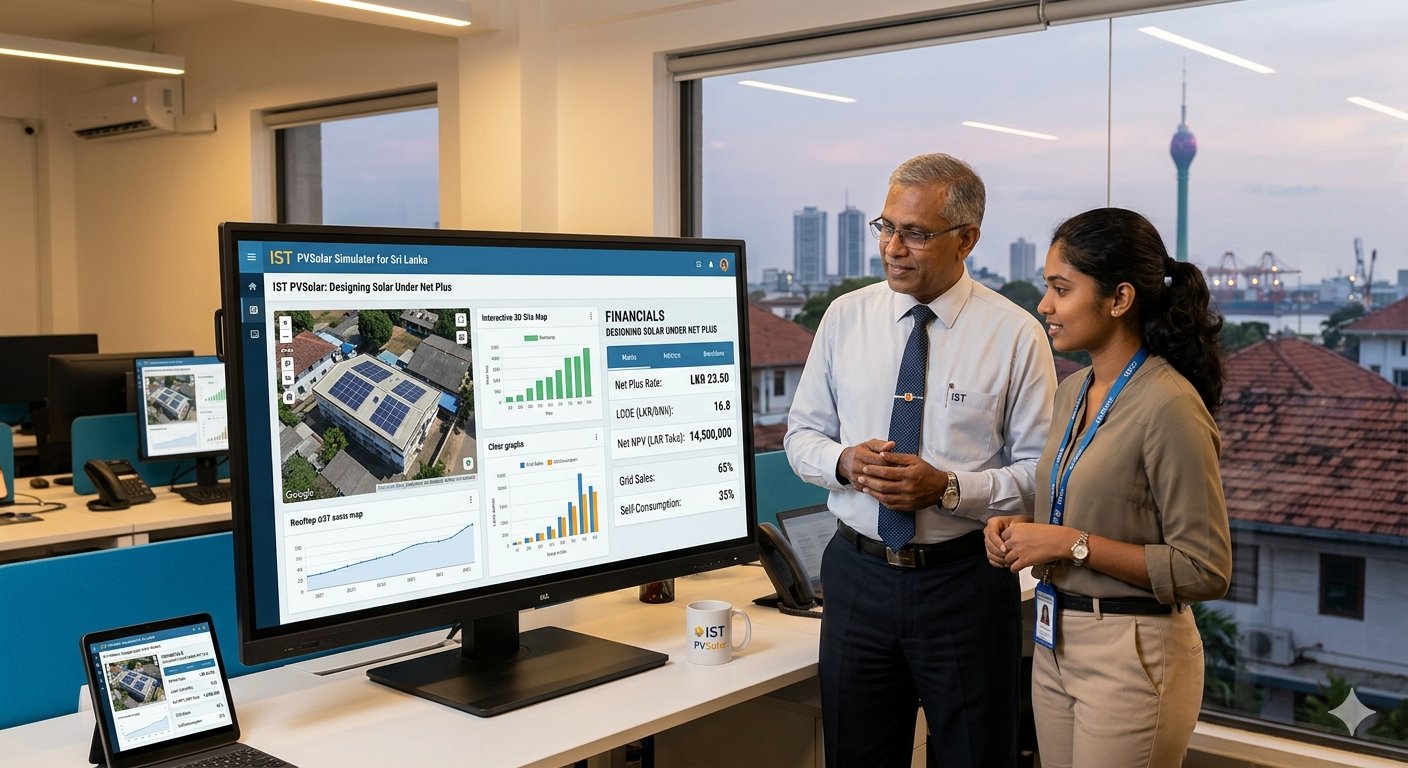
IST PVSolar Simulator for Sri Lanka: Designing Solar Under Net Plus
Sri Lanka has been one of South Asia's fastest-moving rooftop solar markets, and also one of its most policy-sensitive. Rooftop generation grew sharply in 2025, and the rules for exporting power have changed repeatedly since. For a design team, the question is no longer just how much energy a roof will produce. It is how that energy will be paid for under the scheme that applies on the day the agreement is signed.
IST PVSolar Simulator is built around a simple idea: set up the project once, run one simulation, and let the country's currency, tax and export rules shape every report that follows. This article shows how that fits Sri Lanka.
IST PVSolar Simulator can support this workflow by connecting PV system design, energy simulation, financial analysis and engineering documentation in one platform. The important distinction is that the software's local tariff, tax and utility-compliance settings must reflect the applicable Sri Lankan rules rather than automatically assuming that Indian settings apply.
Sri Lanka's published electricity-policy document calls for Net Plus arrangements for rooftop PV agreements, a 10-year term for agreements executed from 1 January 2026, and periodic feed-in tariff revisions. PUCSL also published a July 2026 feed-in tariff review. Therefore, do not automatically use historical export rates as current tariffs; confirm the applicable tariff, contract term and transition rules for each project.
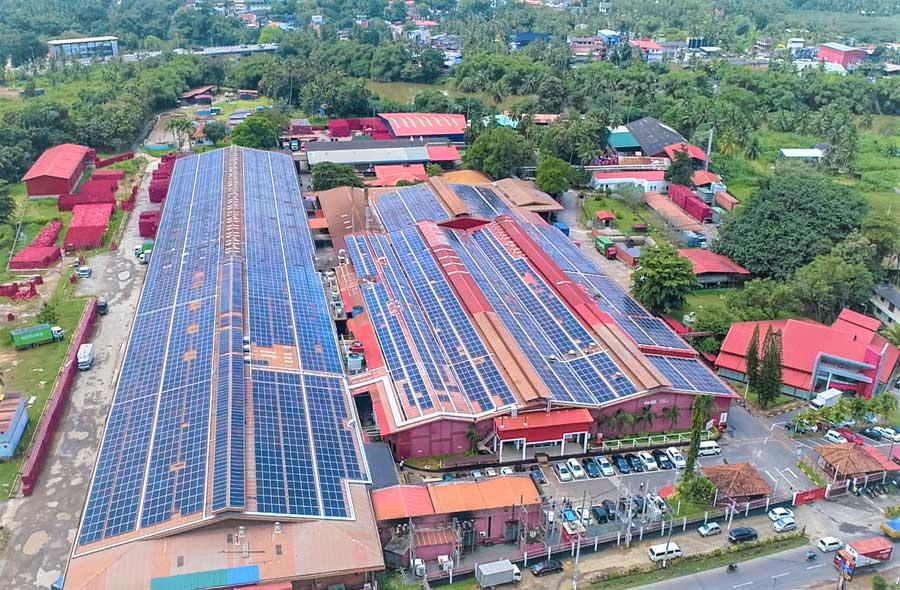
IST PVSolar Simulator can be positioned as an integrated rooftop solar design, simulation and project-evaluation platform for Sri Lankan EPCs, businesses and developers—with LKR financial modelling, configurable tax assumptions, export-scheme scenarios and engineering documentation in a single workflow. Sri Lankan tariff and utility compliance must be validated against current official documents and the project's executed agreement.
Why Sri Lanka needs a country-aware simulator
Three features make Sri Lanka a good test for any solar design tool.
- Multiple rooftop schemes. Net metering, net accounting and net plus have all been offered through the Ceylon Electricity Board (CEB) and Lanka Electricity Company (LECO). Which one applies depends on when and how the project connects.
- Frequent tariff revisions. Feed-in tariffs have been revised several times, and the current rates are valid only for a stated period.
- A steep retail tariff. Sri Lanka's household tariff is tiered, so the value of self-consumed solar can be much higher than the value of exported solar. That changes the best system size.
A simulator that hard-codes one export rule would mislead you. IST PVSolar Simulator treats the export scheme, price, term and size limits as editable inputs, so you can model the rule that actually applies.
LKR costing with 18% VAT
IST's costing workflow can be configured around Sri Lankan project costs rather than INR-based assumptions.
|
Costing parameter |
Suggested treatment |
|---|---|
|
PV modules, inverters and BOS |
LKR equipment cost, including relevant import and logistics costs |
|
Engineering and installation |
Local labour, design, transport and installation costs |
|
Grid connection |
Utility-approved estimates and applicable connection charges |
|
VAT |
Configurable 18% standard-rate assumption, subject to actual tax treatment |
|
O&M |
Annual LKR cost with escalation assumptions |
|
Financing |
Loan amount, interest rate, repayment period and equity contribution |
|
Revenue |
Applicable export tariff and any separate self-consumption savings |
The current policy picture
According to recent reporting, Sri Lanka's Ministry of Energy announced that distributed PV systems connected after 5 March 2026 no longer operate under net metering. New connections instead use the Net Plus mechanism, with agreements capped at 12 years and smart meters required. Existing net-metering and net-accounting contracts reportedly keep their terms.
Reported feed-in tariffs for new rooftop systems, valid until late February 2027, are:
|
System size |
Feed-in tariff (LKR/kWh) |
|---|---|
|
Up to 10 kW |
23.11 |
|
Above 10 kW, up to 40 kW |
19.15 |
|
Above 40 kW, up to 250 kW |
17.11 |
|
Above 250 kW |
15.81 |
|
Solar plus storage, prioritised feed-in period (first 15 years) |
45.53 |
|
Solar plus storage, other periods |
15.81 |
Policy in this area is moving quickly, and reports from different outlets do not fully agree on every detail. One recent report, for example, describes the withdrawal of export payments for surplus energy from new installations from September 2026. Treat the figures above as a starting point and confirm them with CEB, LECO and the Public Utilities Commission of Sri Lanka (PUCSL) before you submit any project.
The country data that drives a Sri Lanka project
The simulator stores country-wise defaults for the inputs below. The table shows what each means for a Sri Lanka project and the publicly reported context. Where a figure depends on your customer category or the current default in the software, the table says so.
|
Input in the simulator |
Sri Lanka context |
|---|---|
|
Currency |
Sri Lankan rupee (LKR, Rs). |
|
Currency rate per 1 US$ |
Reported figures imply roughly LKR 300 to 320 per US$ (LKR 15.81 is quoted as about US$0.05). Enter the live rate when you build the project. |
|
Electricity tariff |
CEB tariffs are tiered by consumption and category. One public calculator uses a blended residential figure near LKR 42/kWh, but you should enter the rate from the customer's own bill. |
|
Tariff escalation (%/yr) |
An editable assumption. Run low, base and high cases, since Sri Lankan tariffs have been revised repeatedly in recent years. |
|
Discount rate (%) |
An editable assumption reflecting your cost of capital in rupees. |
|
VAT / GST on equipment |
18% is the figure the platform's own article gives for Sri Lanka. Confirm the current rate and any exemptions for solar equipment. |
|
CO₂ grid factor (kg/kWh) |
Used for emissions-avoided reporting. Confirm the default in the simulator against the latest published grid factor. |
|
Corporate tax (%) |
Depends on company type and sector. Confirm the applicable rate with your tax adviser. |
|
Depreciation |
Choose straight-line, declining-balance or custom in the financial model to match your accounting treatment. |
|
Export scheme |
Net Plus for new connections, per recent reporting. Net accounting and net metering apply only to existing agreements. |
|
Export fixed price (price/kWh) |
LKR 15.81 to LKR 23.11 depending on system size, as in the table above. |
|
Export credit (× tariff) |
Under Net Plus, exported energy is paid at the fixed feed-in price rather than as a multiple of the retail tariff. |
|
Export rule lasts (years) |
Agreements are reported to be capped at 12 years for new Net Plus connections. The solar-plus-storage priority window is reported as 15 years. |
|
After the term |
Not defined in the sources reviewed. Model a conservative case, such as self-consumption only, for years beyond the agreement. |
|
Export only for systems ≥ / ≤ (kWp) |
The tariff is banded by size, with bands at 10 kW, 40 kW and 250 kW. Check the contract demand and any larger-capacity scheme with the utility. |
|
Utility name |
CEB for most areas, LECO for its service territory. PUCSL is the regulator and the Sri Lanka Sustainable Energy Authority supports renewables. |
|
Grid-connection approval |
Application to the distribution licensee, an agreement under the applicable scheme, and a smart meter for new Net Plus connections. Confirm current requirements. |
|
Net-metering / export policy |
Net metering discontinued for new connections from 5 March 2026, per reporting. Net Plus applies instead. |
|
Export explanation |
The simulator shows how the export rule is applied, so a reader can see how the revenue was calculated. |
A note on accuracy: these figures come from public reporting and policy summaries, not from a certified rulebook. Every field in IST PVSolar Simulator is editable, and administrators can update a country's values with the date and source shown.
Why self-consumption matters more under Net Plus
When the export price is well below the retail tariff, each unit used on site is worth more than each unit exported. In practice, that shifts the design priorities:
- Size the array to the daytime load rather than the roof area alone.
- Test whether a battery lets you shift solar to the evening, where the storage tariff may be more attractive.
- Compare a larger export-oriented system against a smaller self-consumption system on payback and IRR.
IST PVSolar Simulator supports hourly battery dispatch against an imported or estimated load profile, so you can run these comparisons in one project instead of in separate spreadsheets.
One simulation, every document
The core promise of the platform is that a single run feeds every output:
- Energy yield, performance ratio and a full loss waterfall.
- P50, P75, P90 and P95 yields with Monte Carlo uncertainty.
- A single-line diagram, array table, cable schedule and protection schedule.
- NPV, project and equity IRR, LCOE, payback and DSCR, in rupees.
- A bankability report, a Detailed Project Report and an EPC proposal with a bill of quantities.
Change the module, the tariff band or the export rule, run again, and every document updates together.
Engineering that suits Sri Lankan sites
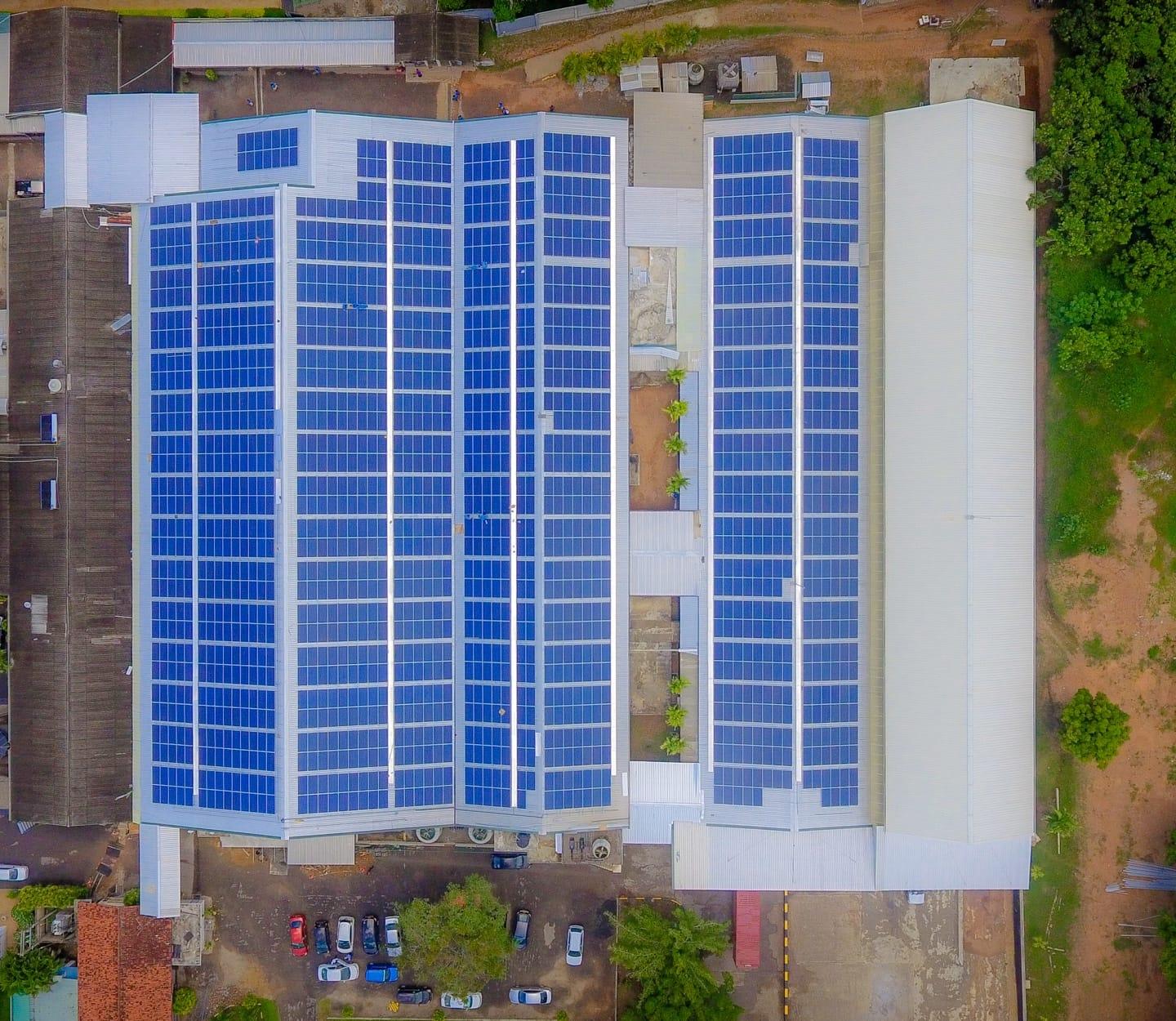
The engine follows international methods, including IEC 61724-1 performance accounting, IEC 61853 module rating, a single-diode cell model, Perez transposition and IEC 60364-7-712 for PV electrical design. The simulation runs hourly or every 15 minutes. It supports 3D shading for rooftops with trees and neighbouring buildings, mixed-orientation arrays, and editable thermal, soiling and degradation losses. Weather data can be imported from PVGIS or NASA POWER in one click, or from your own hourly file.
Who benefits in Sri Lanka
|
User |
What they get |
|---|---|
|
Rooftop EPCs |
Quick quotations, BOQ and utility-ready drawings |
|
Hotels, factories and commercial buyers |
Self-consumption, export and battery analysis in rupees |
|
Developers and investors |
Bankability metrics, DSCR and risk analysis |
|
Consultants and lender's engineers |
Transparent losses, P-values and uncertainty |
|
Universities and trainers |
Research and teaching tools for solar design |
A seven-step workflow for a Sri Lanka project
- Select Sri Lanka, enter the site and import a weather year.
- Set orientation and run shading checks.
- Choose modules and inverters and build the sub-arrays.
- Review loss assumptions, especially soiling, temperature and degradation.
- Enter CAPEX, OPEX, financing, the customer tariff, the export price band and the tax settings.
- Run the simulation, with and without a battery.
- Generate the SLD, schedules, bankability report and DPR.
Frequently asked questions
Does IST PVSolar Simulator support Sri Lanka's Net Plus scheme? Yes. You can set a fixed export price, a size band and a term, and see how the rule affects revenue and payback.
Can I model the older net-metering or net-accounting schemes? Yes, for existing agreements or comparison cases, by changing the export scheme and credit settings.
Can I work in Sri Lankan rupees? Yes. The platform supports multi-currency costing, so CAPEX, OPEX, tariffs and returns can be shown in rupees.
Are the Sri Lanka defaults guaranteed to be current? No. Defaults are editable and should be checked against the latest PUCSL and CEB announcements before submission.
Does it replace utility approval? No. It supports a well-documented design, while approvals, agreements and equipment certification remain the project team's responsibility.
Design once, deliver in rupees
Sri Lanka's rooftop rules are changing fast, so the most useful tool is one that lets you change assumptions without rebuilding the project. With IST PVSolar Simulator, the yield, the finances and the paperwork come from one run, in the currency and rules of the market you are building in.
Read the original One Simulation, Every Report, Any Country article, explore the product page, or create an account to start your first Sri Lanka project.